Posts: 2,163
Threads: 17
Joined: Sep 2014
Reputation:
77
05-26-2015, 11:19 AM
(This post was last modified: 05-26-2015, 11:40 AM by Markster.)
Fun fact!
Apparently the 204 routing presented in the Planning and Works agenda, namely this:
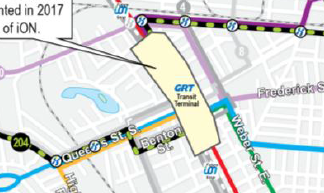
Is not what they were planning on building after all!
I was making a delegation to council, asking that they review the stop locations, given the context of the neighbourhood, and, when staff responded, it turns out that:
1) That iXpress indicator at Highland is eastbound only
2) That iXpress indicator at Mill/Iron Horse Trail is westbound only
3) That routing on Benton is a complete fabrication and not the plan
The bus is being routed into Charles St Terminal after all, they now tell us.
This was, effectively, a gong show. They did not present their actual plan for comment.
There is no apparent planning for what happens in 2 years when ION starts up.
There is no apparent planning for what happens in X years when Charles St Terminal is abandoned.
They are fully willing to spend infrastructure money (concrete pads and shelters) on what is a middlingly-acceptable solution to a temporary situation, thereby enshrining a terrible stop placement in the neighbourhood in perpetuity.
Council amended their motion to refer this stop placement back to staff.
Posts: 165
Threads: 1
Joined: Nov 2014
Reputation:
7
Are there any other mistakes on the route map, going east past King and down Victoria? It looks there's a stop at River, and I would assume all of the denoted stops are both east and west bound.
Posts: 2,520
Threads: 9
Joined: Aug 2014
Reputation:
75
(05-26-2015, 11:19 AM)Markster Wrote: 1) That iXpress indicator at Highland is eastbound only
2) That iXpress indicator at Mill/Iron Horse Trail is westbound only
It is bad form not to have stations/stops across from each other. Obviously this isn't possible all the time, but did they explain why it would be difficult in this case?
I'm glad to hear the 204 will go to Charles Street, since there is so much connectivity there (for now). You're right that they need a plan for after Ion begins.
Posts: 2,163
Threads: 17
Joined: Sep 2014
Reputation:
77
05-26-2015, 03:16 PM
(This post was last modified: 05-26-2015, 03:16 PM by Markster.)
I rambled a huge rant on Twitter about the whole experience:
https://twitter.com/Markster3000/status/...4877750273
TL;DR
![[Image: CF89OTyUIAA7Gdc.png]](https://pbs.twimg.com/media/CF89OTyUIAA7Gdc.png)
Posts: 2,163
Threads: 17
Joined: Sep 2014
Reputation:
77
And I've condensed the whole saga into a Storify, for your reading pleasure:
https://storify.com/Markster3000/grt
Posts: 2,015
Threads: 11
Joined: Oct 2014
Reputation:
77
Markster your efforts are impressive; a re-evaluation is a good outcome.
Clearly the split inbound/outbound stops were not communicated as part of the consultation process. Even if there is good justification for the splitting of the inbound/outbound stops I can't see the rationale for placing them separately from existing stops that are only about 100m away (Queen@Homewood for the inbound, Queen@Joseph Schneider Haus for the outbound) rather than making new stops that only the 204 stops at; that would make Councillor Mitchell's comments about "just get a transfer and take the regular bus" to connect to the 204 even harder to execute in practice.
Is it just me or has there been an increase in the number of bus breakdowns this spring? It seems like I see multiple buses a day broken down or being towed.
Everyone move to the back of the bus and we all get home faster.
Posts: 896
Threads: 2
Joined: Aug 2014
Reputation:
11
Not just GRT; this week I've seen two GO buses at the side of the 401.
Posts: 2,520
Threads: 9
Joined: Aug 2014
Reputation:
75
(05-26-2015, 06:39 PM)Markster Wrote: And I've condensed the whole saga into a Storify, for your reading pleasure:
https://storify.com/Markster3000/grt
Thanks for posting that!
“What it *is*, is a suburban commuter service. Local in the suburbs, then direct to downtown, no stops.”
That’s true, that’s what it effectively is given the wider stop spacing. There actually might not be any problem with that. Having station spaced closer together in the low-density areas might make sense if they are less-frequently used: if say a third of the time, no one is getting on or off there, they do not slow the service down. In the downtown, though, nearly every stop will have a rider either getting on or off nearly all the time- if spacing is 500 meters, that means that the bus is going to stop (maybe for only one or two riders) every 500 meters.
I’m not positive if this is what we’re going for here. To me, the line is supposed to be limited stop, so stops should be limited. At first glance, my opinion was that stops were too closely-spaced in general. If they want to go for an express route that offers limited mobility within downtown to keep it moving as quickly as possible, I can see the merit of that. But that wasn’t communicated, so it’s hard to have a discussion about that.
Good stuff linking to that Human Transit on split routes. Again, I can think of instances where it makes sense. But even when we learned that one stop would be west- and the other east-bound, there was no explanation for why. It’s hard to judge whether this is sensible if they do not communicate their rationale.
Without good info, I am in agreement with all of your points and really grateful for all your energy in trying to address this. I’m sure your neighbours appreciate it!
Posts: 2,163
Threads: 17
Joined: Sep 2014
Reputation:
77
(05-29-2015, 08:33 AM)MidTowner Wrote: I’m not positive if this is what we’re going for here. To me, the line is supposed to be limited stop, so stops should be limited. At first glance, my opinion was that stops were too closely-spaced in general. If they want to go for an express route that offers limited mobility within downtown to keep it moving as quickly as possible, I can see the merit of that. But that wasn’t communicated, so it’s hard to have a discussion about that. Exactly, the communication was terrible for the downtown area. How can there be any reasonable expectation of public input when the information the public has is so suspect?
I'd certainly argue against a suburban commuter ideal of the route, in fact, I'd say that it fails that goal as well. This route should be our Bloor Subway. Nice, even 500~700m stop spacing across town, hitting the major cross-corridors.
Posts: 2,520
Threads: 9
Joined: Aug 2014
Reputation:
75
(05-29-2015, 09:43 AM)Markster Wrote: I'd certainly argue against a suburban commuter ideal of the route, in fact, I'd say that it fails that goal as well. This route should be our Bloor Subway. Nice, even 500~700m stop spacing across town, hitting the major cross-corridors.
I consider 500 meters to be very tight spacing. If we assume a preferred walking speed for most people of around 5kph, 250 meters is only a three minute walk. People are willing to walk much further than that for good service. Having to stop every 500-700 meters makes speed difficult.
Posts: 2,163
Threads: 17
Joined: Sep 2014
Reputation:
77
05-29-2015, 10:08 AM
(This post was last modified: 05-29-2015, 10:10 AM by Markster.)
Well, I guess Toronto better close Bay subway station...
I use the Bloor subway as a comparison for a reason. It's got stop spacing as tight as 450m in the core, expanding to 600m on the fringe, 800m in the outer areas, and +1km at the ends. For the record, a Highland-Courtland-King stop spacing is 700m between stops.
cdklein wrote a blog post, bringing this up:
http://waterloons.blogspot.ca/2015/05/th...-stop.html
Quote:Density provides transit ridership through increased trip generation. Promixity to good transit service also drives ridership. Good transit service is partly driven by route speed, which is negatively affected by the number of stops along the route, so that is a major tradeoff. For most of its history, GRT has actually had too many stops on its routes, slowing down buses, raising costs and making its service less compelling.
But in attempting to deal with this problem, the region wants to treat all places the same. Stop spacing over 1km apart makes for rapid buses through our suburbia, and is an acceptable tradeoff between service quality and availability. But stop spacing at this scale within an urban core doesn't just affect downtowners, but also the potential suburban users who may head there.
[...] does it make sense to treat a dense urban cluster of apartment buildings, with multiple seniors' residences and other attractions as a place with the same transit need as a suburban hinterland of single family homes on widing avenues? Can we afford to ignore the ridership potential of parts of our downtown cores presented with poor access to transit that runs right by their front doors?
Posts: 2,520
Threads: 9
Joined: Aug 2014
Reputation:
75
05-29-2015, 10:30 AM
(This post was last modified: 05-29-2015, 10:31 AM by MidTowner.)
(05-29-2015, 10:08 AM)Markster Wrote: Well, I guess Toronto better close Bay subway station...
I use the Bloor subway as a comparison for a reason. It's got stop spacing as tight as 450m in the core, expanding to 600m on the fringe, 800m in the outer areas, and +1km at the ends. For the record, a Highland-Courtland-King stop spacing is 700m between stops.
I'm not sure it's the most appropriate comparison; I certainly wasn't referring to the Bloor subway line when I referred to 500 meter spacing as very tight, so don't read into it that I think Bay station should be closed or anything else.
A subway system is different from a bus system operating in mixed traffic with on-board fare payment. There is a significant time penalty every time a bus has to slow down, merge out of traffic, wait to unload passengers, wait for passengers to get on and pay their fares. If we're talking about that stretch specifically, I would say that stop spacing makes logical sense given the trip generators there. In general, though, I think there's a lot to be said for wider spacing given the impact on speed and the cost of it. As the post you linked to mentions, GRT has until very recently had far too many stops. I still don't think it has the opposite problem.
Regarding the wide stop spacing you mention at the ends of the Bloor line, a subway station can't be compared to a bus stop that may not even have a shelter or even a bench. A subway station is a huge investment; they can not be built where ridership won't eventually justify them. A bus stop is an investment, but tiny relative to a subway station. I am not in favour of a strong focus on coverage if it means making sure everyone has crummy service, but if a bus line is going to go through a relatively sparse area, I think that it sometimes makes sense to give that sparse area more stops, since they are relatively low capital investment, and relatively infrequently going to result in delays (since relatively few people use them), but still serve goals of coverage. That's not true in denser areas, where 500 meter stop spacing might result in stopping every 500 meters, every time.
Posts: 2,163
Threads: 17
Joined: Sep 2014
Reputation:
77
(05-29-2015, 10:30 AM)MidTowner Wrote: I'm not sure it's the most appropriate comparison; I certainly wasn't referring to the Bloor subway line when I referred to 500 meter spacing as very tight, so don't read into it that I think Bay station should be closed or anything else. Indeed, you weren't referring to Bloor, I was when I said "This route should be our Bloor Subway".
450m spacing in a downtown can be justified because the density of destinations is there.
I don't think that a suburban commuter express is the kind of service we need to be introducing in order to be encouraging the intensification goals that the city has. I'm looking for a service that is appropriately close to everyone along its route, allowing all along its route to make useful trips.
Amusingly, the reason for the split stop at Highland/Mill:
Those were the places where they could find space to build full iXpress shelters as close to Highland as was convenient. That appears to be the entire reasoning behind the stop locations.
Posts: 2,520
Threads: 9
Joined: Aug 2014
Reputation:
75
I don't think the 204 can be our Bloor subway, since we're not talking about Bloor and it's not a subway. A subway and bus service do differ in many important ways.
The 204 is not a local service. It is being characterised as limited stop/express. Those types of services do not have 450 meter spacing. There are bus stops within two hundred meters of pretty much anywhere downtown, but they'll not all be served by any one route, and certainly not by a route that is intended to be fast. The trade-offs to save some riders a few hundred meters of walking are not worth slowing down a route whose branding is "express."
That might be a good reason for a split stop, but they should be more specific. If it's merely inconvenient, that's not a good reason at all. Inconvenient how? That's still insufficient communication on their part about something that's pretty important.
Posts: 744
Threads: 2
Joined: Aug 2014
Reputation:
13
(05-29-2015, 11:17 AM)MidTowner Wrote: The 204 is not a local service. It is being characterised as limited stop/express. Those types of services do not have 450 meter spacing.
It is both a limited stop service and a local service, being the only service to travel its corridor. The thing iXpress routes (after the 200) are most similar to is European bus routes that don't follow the North American anti-pattern of stopping every block, but are nevertheless fully intended to serve their entire corridor.
|



